


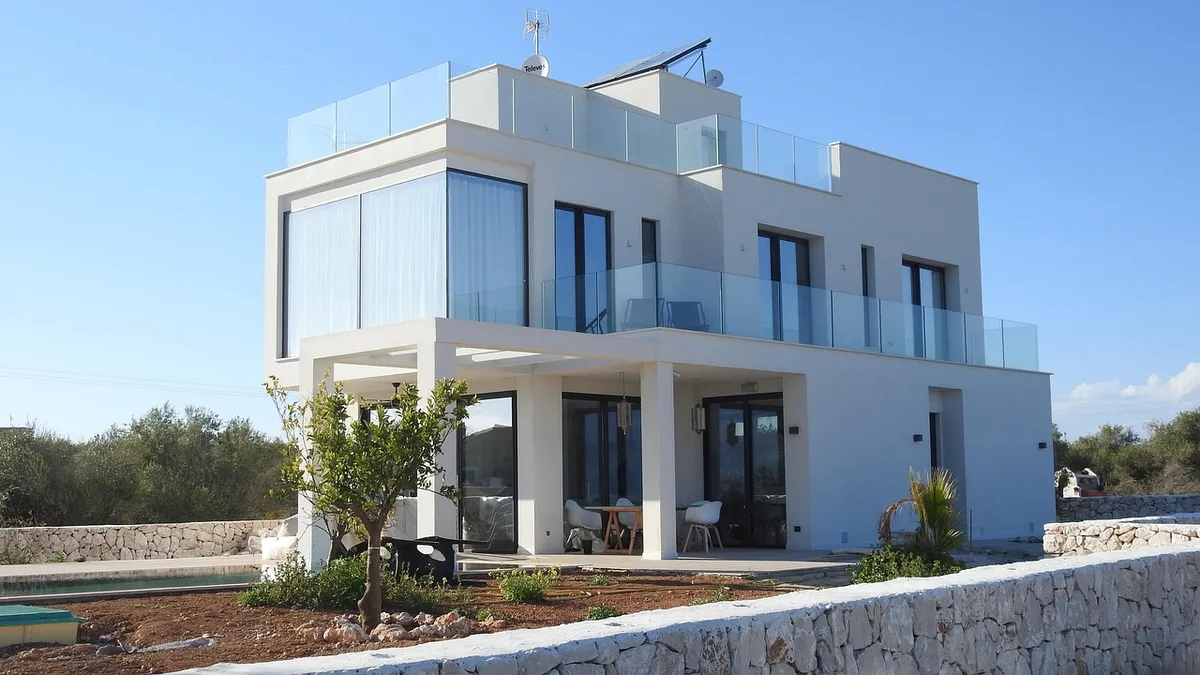
Budapest real estate prices by district range from roughly €1,200–€1,800 per square metre in outer districts like District XVI or XX, up to €4,000–€6,000 per square metre in prime inner-city districts such as District V and District XIII. The city-wide average for residential apartments sits around €2,500–€3,000 per square metre in mid-2026, with significant variation based on condition, floor level, and proximity to metro lines.
How Budapest property prices are structured
Budapest is divided into 23 districts, numbered in a rough spiral from the historic centre outward. Prices do not follow a simple gradient — a flat in District VIII can cost more per square metre than one in District XIV, depending on the street and the renovation standard. Understanding the district system is the first step to making a meaningful price comparison.
The Hungarian property market quotes prices in Hungarian forints (HUF), but most listings aimed at foreign buyers also show euro equivalents. For reference, the EUR/HUF exchange rate has hovered around 390–410 HUF per euro through the first half of 2026. All euro figures in this guide use approximately 400 HUF/EUR as a working rate.
Condition matters enormously. A newly renovated 60 m² flat in District VII can fetch €3,500/m², while an unrenovated flat on the same street may be listed at €2,000/m². Buyers comparing listings should always check whether the price reflects a turnkey finish, a shell renovation, or a property that needs full gut-out work. You can browse current stock across all conditions in the Budapest property listings to get a live sense of the spread.
District V and VI: the premium inner city
District V — the Belváros-Lipótváros district — is Budapest’s financial and administrative core. It contains the Hungarian Parliament, the Chain Bridge, and Váci utca. Renovated apartments here regularly list at €4,500–€6,000 per square metre. A 50 m² one-bedroom flat in a historic building near Szabadság tér can easily exceed €250,000. Supply is constrained because the building stock is almost entirely pre-war, and new construction is rare.
District VI, anchored by Andrássy Avenue (a UNESCO World Heritage Site), commands similar premiums. The Oktogon and Liszt Ferenc tér areas attract both short-term rental investors and owner-occupiers. Expect €3,800–€5,500/m² for renovated stock. Unrenovated flats in the same streets can still be found at €2,200–€2,800/m², which is why District VI remains a target for the renovate and resell strategy.
Both districts carry high short-term rental demand, but Budapest’s city council has tightened Airbnb-style licensing since 2024. Buyers targeting rental income should verify the current licensing status of any specific building before purchase.

District VII and VIII: the ruin-bar belt and its transition
District VII (Erzsébetváros) built its reputation on the ruin-bar scene around Kazinczy utca and Gozsdu Udvar. That tourism footprint drove short-term rental investment through the late 2010s and early 2020s. Prices for renovated flats in the core of District VII now sit at €3,000–€4,200/m². The district has gentrified significantly, and the gap between renovated and unrenovated stock is wide — unrenovated units can still be found at €1,800–€2,400/m².
District VIII (Józsefváros) is more varied. The Corvin Quarter, a large urban regeneration project around Corvin köz, has produced modern residential buildings priced at €2,800–€3,500/m². Streets closer to the Keleti railway station or the outer parts of the district remain cheaper, with older stock at €1,500–€2,200/m². District VIII is one of the few inner-city districts where a buyer with a budget under €100,000 can still find a liveable one-bedroom flat, though competition for those units is real.
District VIII’s Corvin Quarter is one of the most significant urban regeneration projects in Central Europe, replacing a dense 19th-century tenement block with a mixed-use neighbourhood that now includes cinemas, offices, and modern residential towers.
District XIII: the fastest-growing mid-market district
District XIII has been the standout story of Budapest real estate over the past five years. The Újlipótváros neighbourhood — bounded by the Danube, Margaret Island, and Váci út — has attracted a wave of young professional buyers and international investors. New-build apartments along Váci út and around Lehel tér are priced at €3,200–€4,500/m². Older stock in the same district trades at €2,400–€3,200/m².
The district’s appeal is practical: it has direct metro access (M3 line), a large covered market at Lehel, and Margaret Island within walking distance. Several large-scale residential developments completed between 2022 and 2025 have added modern supply, which has kept price growth more measured here than in District V or VI. For buyers seeking a balance between central location and value, District XIII is consistently worth examining — the Budapest apartment sales page regularly features listings here.

Districts I, II, and XII: the Buda hills premium
The Buda side of the Danube carries a different kind of premium — quieter streets, more green space, and a perception of exclusivity that has persisted for generations. District I (Várhegy, the Castle District) is the most historic and the most expensive on the Buda side, with renovated flats at €4,000–€5,500/m². Supply is extremely limited; the Castle District is a UNESCO World Heritage Site and new construction is tightly controlled.
Districts II and XII cover the Buda hills and the residential neighbourhoods of Rózsadomb, Pasarét, and Hűvösvölgy. Detached houses and larger family homes dominate here. A well-maintained family house in Rózsadomb (District II) typically lists at €600,000–€1,500,000 depending on size and garden. Apartments in the same district range from €2,800–€4,500/m². These districts attract affluent Hungarian families, diplomats, and buyers who prioritise air quality and school catchment areas over nightlife proximity.
District XII (Hegyvidék) offers slightly lower prices than District II for comparable properties, with apartments at €2,500–€3,800/m² and houses at €400,000–€900,000. The Cogwheel Railway and proximity to the Buda hills make it popular with families.
Outer districts: where affordability still exists
Districts XIV through XXIII form the outer ring of Budapest. These are predominantly residential areas with lower density, more panel-block (prefabricated concrete) housing stock, and significantly lower prices. The trade-off is longer commute times and fewer walkable amenities.
District XIV (Zugló) is the most sought-after of the outer Pest districts, largely because of its parks (Városliget, Puskás Ferenc Stadion area), good public transport links, and reputation for family living. Prices here have risen steadily and now overlap with the lower end of inner-city districts. For buyers whose priority is space over central location, the outer districts offer genuine value — see the full range of properties for sale in Budapest across all districts.
What drives price differences between districts
Several factors explain why two flats of identical size can differ by €2,000/m² or more within the same city. Metro and tram access is the single biggest infrastructure driver — properties within 500 metres of an M2, M3, or M4 metro station consistently command a premium over those served only by buses. The M3 line’s full renovation, completed in stages through 2023, lifted values along its corridor noticeably.
Building age and type also matter. Pre-war buildings with high ceilings, ornate facades, and solid brick construction are preferred by both owner-occupiers and short-term rental investors. Panel-block flats (panellakás), built during the socialist era, trade at a structural discount even when renovated, because of their lower ceiling heights and standardised layouts. New-build apartments occupy a separate segment — they carry a VAT component in their pricing and typically sell at a premium to comparable older stock in the same district.
Short-term rental potential has historically inflated prices in Districts V, VI, and VII. As licensing restrictions tighten, some of that premium is unwinding, which creates opportunities for buyers focused on long-term residential use or traditional long-term letting. If you are weighing the investment case, the why invest in Budapest page sets out the broader rationale.
Buying costs and taxes buyers must budget for
The purchase price is not the total cost. Buyers in Hungary pay a property transfer tax (vagyonszerzési illeték) of 4% of the purchase price for residential property. First-time buyers under certain conditions may qualify for a reduced rate or exemption — the rules change periodically, so confirm the current position with a lawyer or tax adviser before relying on any exemption.
- Property transfer tax: 4% of purchase price (standard rate for residential)
- Legal fees: typically 0.5%–1% of purchase price for a Hungarian property lawyer
- Land registry fee: a fixed administrative fee, currently a few tens of thousands of HUF
- Agency commission: varies by agency; some charge 3%, others up to 5%
- Renovation reserve: for older stock, budget at least €300–€600/m² for a full renovation
On a €200,000 apartment, the transfer tax alone adds €8,000. Legal fees add another €1,000–€2,000. Total transaction costs typically land between 5% and 7% of the purchase price for a straightforward residential purchase. Buyers using a mortgage from a Hungarian bank will also face valuation and arrangement fees. Foreign buyers should also factor in currency conversion costs if purchasing in HUF from a non-HUF account.
Agency commission is negotiable in Budapest. Some agencies charge 5% or more; others, including those focused on foreign buyers, work at 3%. On a €250,000 purchase, that difference is €5,000 — worth asking about before signing a mandate.
Frequently asked questions
- Which Budapest district has the highest property prices?
- District V (Belváros-Lipótváros) consistently records the highest prices per square metre for residential apartments, typically €4,500–€6,000/m² for renovated stock in mid-2026. District I (the Castle District) on the Buda side is comparable, but has very limited supply. District VI on Andrássy Avenue is a close third.
- Can foreigners buy property in Budapest?
- EU citizens can buy residential property in Budapest on the same terms as Hungarian nationals. Non-EU citizens can also purchase apartments freely, but buying agricultural land or certain protected areas requires government permission. Setting up a Hungarian company is one route some non-EU buyers use to simplify the process. A qualified property lawyer should advise on the current rules for your specific nationality.
- Is District XIII a good investment in 2026?
- District XIII has shown consistent demand from both owner-occupiers and long-term rental investors, driven by metro access, proximity to Margaret Island, and a large volume of new-build supply that keeps the market liquid. Prices are lower than Districts V and VI while still being central. Whether it suits your investment goals depends on your target yield, hold period, and exit strategy.
- What is the average price per square metre in Budapest in 2026?
- The city-wide average for residential apartments in Budapest in mid-2026 is approximately €2,500–€3,000 per square metre, blending inner-city premiums with outer-district affordability. New-build apartments typically sit above this average; unrenovated older stock in outer districts can be well below it.
- How much does a one-bedroom apartment cost in Budapest?
- A one-bedroom apartment (roughly 35–55 m²) in an inner district like VII or XIII typically costs €90,000–€180,000 depending on condition and exact location. In outer districts, similar-sized flats can be found for €50,000–€100,000. In prime Districts V or VI, a renovated one-bedroom rarely lists below €150,000 and often exceeds €250,000.
- Are Budapest property prices rising or falling in 2026?
- After a period of price correction in 2023–2024 driven by higher interest rates and reduced purchasing power, Budapest residential prices stabilised through 2025 and have shown modest nominal growth in early 2026. The pace varies sharply by district and property type. New-build prices have held firmer than older stock in most areas.
- What are the ongoing costs of owning a Budapest apartment?
- Ongoing costs include building maintenance fees (közös költség), typically €30–€150 per month depending on building size and services; local property tax (építményadó), which varies by district but is generally modest; and utility costs if the property is occupied. Rental income is subject to Hungarian personal income tax, currently at a flat 15% rate for individuals.
- Is it better to buy in Buda or Pest?
- Buda offers more green space, quieter streets, and a different lifestyle, but prices in Districts I, II, and XII are high and supply is limited. Pest — particularly Districts V, VI, VII, and XIII — offers more liquidity, more rental demand, and a wider range of price points. Most foreign investors focus on Pest; families and lifestyle buyers often prefer Buda. The right answer depends on your use case.